Introduction
Puzzles are really fun. They’re exciting adventures from start to finish, with obstacles that require tactics and fun mechanics to solve. They blend well with RPGs, and they are enjoyed by all types of gamers (except maybe the avid story-lovers, and fans of interactive fiction). But how to make an intriguing puzzle? How do you create a problem that’s not too easy that they can solve it in a cinch, but also not so frustrating that they want to hit their head on the keyboard repeatedly? In this article, we will discover the things that make puzzles interesting and fun, and also some tips on how to design them for maximum fun.
Sounds good? Let’s get started.
obligatory screenshot of Braid
What is a good puzzle?
We all know what a good puzzle is. When we play it, we feel smart, and we feel like we can solve any problem that comes our way. But how to design one? And what exactly makes a puzzle a puzzle in the first place? In Tetris, blocks scroll down the screen, and you can move left/right/rotate to make rows that score you points and prevent you from dying. But what makes this fun? Why is this addicting?
 Tetris, a.k.a. Video Game Crack
In a good puzzle game, the objective is always clear. There is a clear start point that you start from, and your goal is to get to the finish point. The rules are clear too, usually from playing around with the mechanics until you realize what is actually happening. In a game like Sokoban, you push boulders/crates around the map until you get to a desired position. The game progresses in difficulty, as each level introduces a new and challenging strategy to the game. In more modern games, a new mechanic is introduced, which will either help/hinder you from getting to your goal.
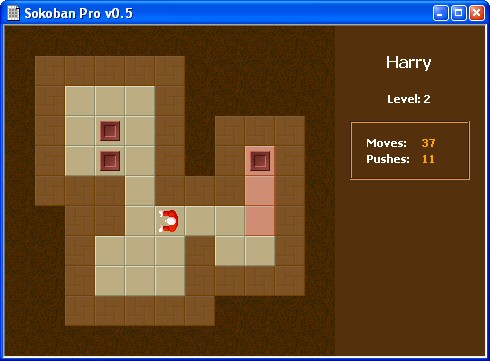 Sokoban. The cliche'd staple of RPG-related puzzles.
Sometimes a puzzle has multiple solutions. This is usually due to the simple mechanics reacting in interesting ways, so that it requires creativity to formulate a solution to the puzzle. These are usually unexpected and fun, but can lead to confusion if the learning curve isn’t moderated correctly.
How to make a good puzzle?
As you are walking around doing your everyday things, e.g. shopping and going to school, ideas will pop into your head for what you might like in your puzzle game. You begin to ask questions like: “What will happen if that tile rotates when you step on it,” or: “Can I put switches in it that when you step on them, the spikes on either side go up?” This is how inspiration comes to us as humans, whether it be for video games, or art, or music, or any other creative idea.
 Hmm... Sokoban + GTA + Dance Dance Revolution... it'll be a hit!
Think about it yourself. Start coming up with ideas for puzzles, and start simple. Once you get these ideas, it’s time to start drawing up your ideas for your game. Once you have got a good idea of what puzzle game you want to make, now it is time to start creating it! So, what are we waiting for? Let’s get to it!
Now, if you immediately opened up your favourite engine to start laying down tiles like crazy, you are definitely doing the wrong thing. Laying tiles down like crazy without a definite plan often leads to jumbled, conceptless levels that are neither fun nor interesting. Instead, create a plan on paper/photoshop/excel or any other note-taking device before you even dare touch your engine. Again, planning is key here, so don’t be lazy.
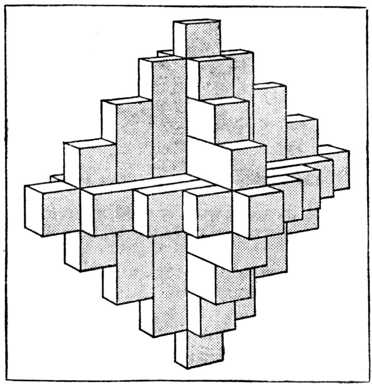 "What is this puzzle? Russian?" "No, it took its time."
The first thing you going to want to do is create the start point and the end point. Don’t be overly ambitious; they don’t need to be too far apart. Now, after you have done that, create what feels like an appropriate number of obstacles between the player and their goal. Don’t go crazy with this, you don’t want to make an intensely difficult puzzle, you just want to tease the player with your mechanics in interesting ways.
Now you can open your engine and create a prototype of the level, and iterate it until it ‘works’. Tweak and tweak it until it feels ‘just right’ (you’ll have to trust your gut here). And voila! You have your puzzle! Congrats, pat yourself on the back. But remember to playtest it like crazy first (I discuss this in a later section). But overall, creating puzzles is fun and cool. Don’t do drugs, kids. Instead make puzzles. Then you can be like me. Yeah, coz I’m so cool. I’m cooler than school.
 Congrats bro! Your puzzle is difficult *and* nonsensical!
So, remember, your goal as a puzzle designer is not to overwhelm your player with difficult puzzles, but to ramp up the difficulty slowly, without making it feel overly repetitive. Our gameplay is dictated by the mechanics of the game. It usually works by introducing one mechanic at a time, and then allowing them to play together like little kindergarten children on a playground. Combining simple mechanics with other simple mechanics can make a truly complex and thrilling puzzle, and is the basis for most puzzle games nowadays.
How to introduce new mechanics to make the game interesting?
When you introduce a new mechanic, you have to let it simmer a little. Introduce it on its own first, so the player can interact with the mechanic without having everything explained to them. Let them play around with it first, getting the feel of it, before continuing on with the more complex puzzles. As the player progresses in your game, they get a better understanding of the game’s rules, which allows them to solve more complex puzzles.
 Guys, I'm a real puzzle game, OK? OK!?
With every new mechanic you introduce, the number of possible puzzles increases exponentially. When you put a few core mechanics together, they can display what game developers call “emergent gameplay”, where the player is allowed to play around with the mechanics in interesting and new ways. Think of Minecraft, and how the player is free to do what they want, when they want, experimenting with the different mechanics as they please. This is the same with puzzles, in that the simple mechanics (e.g. jumping, bouncing, moving boulders, switches for spikes) can combine together to allow the player to explore creative solutions that you might have never even imagined.
How do I judge the learning curve?
Playtesting. Playtest, playtest, playtest. This is one of the most underrated aspects of game development in general. If a player is stuck on a puzzle, they’re likely to get frustrated and ragequit. Sometimes player’s don’t realize the thing that you thought was so blatantly obvious, so much that you feel like screaming “it’s there! The switch is over there, and it opens this.” But you are to never do that with testing; instead you just watch and take note every time you cringe. Then you know there’s a problem that needs to be fixed.
 A steep learning curve breeds character, young man!
You can even track data about the testers, such as the duration it took to complete each puzzle, or finding which puzzles they found too hard, or too easy. Playtesting with people who have never touched the game before is key. A game developer is the most familiar with their own game than anybody else, and thus the solution is almost always apparent to them. But with a new player, they don’t assume what you assume, and what might seem so obvious, is in fact not obvious at all to the new player. They will do the same thing over and over again, expecting different results, and you might cringe because of it, but you will have pinpointed a very important problem in your game, and it’s worth it.
Remember to include easy levels to keep your player’s morale up. Nothing’s worse than completing a very difficult level that took you 5-10 minutes to complete, only to be faced with an even harder-looking one. That’s a sure recipe for a ragequit, right there. After a difficult puzzle, hit them with an easy one, so they say, “Ah, that’s easy.” And then you can get right back to the hard stuff.
How do I avoid player confusion?
Always try to make it easy and obvious to see what elements are in your puzzle. Visual cues are important here, and there should be no obscured tiles. You don’t want to agonize over a puzzle for 10+ minutes, only to realize there’s a chest behind that tree that contains that item that you were looking for this whole time. Don’t conceal puzzle pieces.
 OH OK DOGGIE I NO TELL ANYBODY
Also, no wall of text. Haven’t you learned by now that nobody reads those anyway? In my opinion, you’d rather a person learn by playing rather than by reading. Very few people read tutorial text at all, and think of if you were playing the game, whether you’d read the text or not. I know I wouldn’t.
Try to anticipate misunderstandings of the game’s rules. If understanding of a mechanic is required, then make it compulsory to understand it to continue. For example, if you need to learn how to use gravity manipulation, then make the door exit on the roof or something, so that they have to learn how to use it to continue. Then there will be no misunderstanding about how it works.
Conclusion
Puzzles are cool. They’re really cool. They’re one of my favourites. I hang out with them all the time: at the bar, eating out at the pizza parlour, having a drink with puzzles after graduation. And puzzles are reaaaaaaaally good in bed. But no-one likes bad puzzles. Nobody.
 Peace out, my rad homie! Wut wut!!!!!
本贴来自国际rpgmaker官方论坛作者:C-C-C-Cashmere处,因国际论坛即将永久关站,为了存档多年珍贵资料,署名转载到本论坛存档,由于官方帖子为英文原帖,需要中文翻译请点击论坛顶部切换语言为中文就可以将帖子翻译成中文浏览,方便大家随时查看,原文地址:
https://forums.rpgmakerweb.com/threads/puzzle-design-how-to-make-them-fun-and-addicting.40408/  简体中文
简体中文
 English(英语)
 日本語(日语)
 Deutsch(德语)
 Русский язык(俄语)
 بالعربية(阿拉伯语)
 Türkçe(土耳其语)
 Português(葡萄牙语)
 ภาษาไทย(泰国语)
 한어(朝鲜语/韩语)
 Français(法语)

 聊天机器人
聊天机器人




 窥视卡
窥视卡 雷达卡
雷达卡



 发表于 2026-7-8 09:38:08


 提升卡
提升卡 置顶卡
置顶卡 沉默卡
沉默卡 喧嚣卡
喧嚣卡 变色卡
变色卡 千斤顶
千斤顶 照妖镜
照妖镜